|
Abu simbel
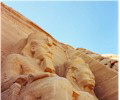
Some 175 miles/280 km s of Aswan and 25 miles /40 km n of the Egyptian-Sudanese frontier at Wadi Halfa , near the second cataract (now drowned under the waters of Lake Nasser ), are the **rock temples of Abu Simbel, which rank among the most stupendous monuments of ancient Egypt. Both temples were constructed during the reign of Ramesses II (129024 b.c.) to mark the 30th anniversary of his accession. The larger of the two temples was dedicated to Amun-re of thebes and re-harakhty of Heliopolis, the principal divinities of upper and lower Egypt , but ptah of Memphis and the deified Ramesses himself were also worshiped here. The smaller temple to the n was dedicated to the goddess Hathor and Ramessese II"s favorite wife Nefertari, also deified.
History.- we can only speculate why Ramesses decided to construct such magnificent temples on this particular site. Probably there were already cave sanctuaries here at a very early period, since such sanctuaries were numerous in Nubia. With the creation of a temple dedicated to himself Ramesses became the first pharaoh to take the final decisive step towards equating king and god; and at the same time the construction of the temples symbolized his royal and divine claim to rule the flourishing region of Nubia, the gold and copper of which were of great importance to Egypt. In addition the treasuries and store-rooms hewn deep into the rock provided a place of security for the riches acquired by war or the payment of tribute.
In the course of millennia many armies, merchants, caravans and other travelers passed this way, often leaving inscriptions and graffiti which throw light on the circumstances of the period. Traces of soot inside the temples show that they were sometimes used as dwellings. Later both temples were buried under the desert sand and sank into an oblivion which lasted until the early years of the 19th c. on march 22, 1813 the Swiss traveler Johann Ludwig Burkhardt the (1784-1817) discovered the heads of the colossal figures of Ramesses emerging from the drifts of sand, but was unable to establish what they were or to penetrate into the interior of the temple. The systematic excavation of the temples was begun by an Italian, Giambattista Belzoni (1778-1823), in 1817, and thereafter they ranked among the principal sights of Egypt.
New dangers threatened the Abu Simbel temples when work began on the construction of the Aswan high dam (Sadd el-Ali) on January 9, 1960, since the site of these unque monuments would be swallowed up by the rising waters of Lake Nasser, the huge reservoir to be created by the new dam. At the joint request of Egypt and Sudan Unesco put in train a massive rescue operation which saved the two temples for posterity. After decisions had been reached on responsibility for the expenditure involved there was much discussion of possible means of saving the temples. Among the projects considered were plans (put forward by the United States) for floating both temples on pontoons, which as the lake rose would carry them up to a new site on higher ground, and a Polish proposal for enclosing the whole site within a spherical shell into which visitors would descend in lifts. Another proposal for was to enclose the site in a kind of glass aquarium and take visitors down to see it in enclosed glass cabins. Most of the plans put forward were rejected on either technical or aesthetic grounds, and the only proposal which seemed acceptable was a French one. This involved cutting both temples out of the solid rock in their entirety, setting them on huge slabs of concrete and then raising them to a new site by the use of hydraulic jacks. To raise the larger temple, weighing 265.000 tons, 440 jacks would have been required, for the smaller temple, weighing 55,000 tons, 94 jacks. But this project, too-com-parable in its boldness with the original construction of the temples- had to be abandoned on account of the gigantic cost.
Finally, as the level of the lake continued to rise and time grew ever shorter, the decision was taken to adopt proposal put forward by the Egyptian sculptor Ahmed Osman for sawing the temples into manageable blocks and re-erecting them on higher ground near their original sites. The costs estimated at 36 million US dollars, were to be shared equally by Egypt, the United States and Unesco. The contract for the execution of the project was given to a consortium of six international civil engineering firms (Grands Travaux de Marseille, Paris; Hochtief, Essen; Impregila, Milan; Skanska, Stockholm; Sentab, Stockholm; Atlas, Cairo) under the name of "Joint Venture Abu Simbel".
Since there was no existing infrastructure at this desert site it was necessary in the first place to establish an adequate system for supplies and communications for 200 people was provided, with all necessary shopping facilities and social amenities. This new settlement forms the core of a much larger town planned for the future in the center of an oasis supplied with water from Lake Nasser.
When work began on the construction of New Abu Simbel in the spring of 1964 the water-level of Lake Nasser was already so high that the temples had to be protected by a coffer-dam. They were then swan up into blocks of a maximum weight of 20 tons (807 blocks for the larger temple, 235 for the smaller), the cutting lines being so arranged that the joins would be as inconspicuous as possible when the temples were re-erected. The blocks, carefully numbered, were then stored until the new site, 215 ft/65 m higher up and 200 yds/180 m farther NW, was ready to receive them. Thereafter the smaller temple had to be raised another 6.5 ft/ 2m as a result in a change in the design of the High Dam, so that there is now a difference in height between the two temples of only 6 ft/ 1.80 m (previously 12.5 ft / 3.80 m). The interior walls and ceilings of the temples were suspended from a supporting framework of reinforced concrete which provides increased stability. The loss of stone resulting from the sawing process was made good by a mortar of cement and desert sand. The re-erected temples were roofed over by massive reinforced-concrete domes with spans of 165 ft/ 50 m and 80 ft/24 m and internal heights of 60 ft/ 19 m and 25 ft/ 7 m respectively which provided support for the mass of rubble and rock covering the whole structure and which also accommodate the necessary tourist facilities (movie-theater, refreshment-room, etc.). By the summer of 1968 the work was completed and a cultural monument of outstanding importance had been preserved for future generations. After the re-erection of the larger temple a slight displacement of its principal axis was detected.
|