|
A strip of green in the middle of the desert tilled fields and in the background the red rocks of the "Libyan Chain" Here lies Luxor, one of the greatest capitals of the ancient world.
Charming and evocative, with the Nile along the quiet waters of the river, the small, silent streets of the Bazaar that come to life in the evening with their colours, sounds and lights.
This is the great, ancient city of Thebes, capital of the Egyptian empire for almost one thousand years, which Homer referred to in the IX canto of the Iliad as "Thebes with one hundred gates" and for which "only the grains of sand in the desert surpassed the abundance of wealth contained therein". The Copts called it Tapé, hence the Greek Thebai, but for Egyptian inhabitants it was Uaset, meaning "the chief town" and Niut, "the City" it was later on called Diospolis Magna. Its present name of Luxor comes from the Arab El Qousour, translation of the Latin "Castra" with which the ancient Romans indicated the city where they had installed two encampments.
 |
In the Memphis era it was a small village where the God of War Montu was worshipped and its temples marked the boundaries of the territory. As from the X Dynasty, thanks to its geographical position and political grounds, its importance started to increase considerably until the military successes of its princes made it a great power. Capital of the pharaohs of the New Empire, the god Amon was worshipped in great splendour in the triad in Mut and Khnsu. It was the age of great victories and triumph in Asia Minor, Nubia and Libya. It was a happy period – perhaps the happiest in Egyptian history – and Thebes had no rivals : victorious Pharaohs accumulated incredible wealth there (city where the houses are rich in treasure) from war booty; from the Red Sea the Persian Gulf and even from the Sahara – across the road of the oases – merchants arrived to grow rich and to enrich the townsmen of Thebes who reached the incredible figure of half a million!
One the east bank rise the temples in which the gods dwelt whereas on the west bank building were constructed for the worship of dead sovereigns; apart from this theory of temples, parallel to the river runs the heavy rock curtain that conceals the Valley of the Kings.
Thebes then inexorably fell. The very geographical position that one thousand years beforehand had favored the birth of its power now became the main reason for its decline : too far from the "hot" delta region, where the Ramses were forced to create military stations to stem foreign invasions, Thebes lost its political, spiritual and military supermacy. Subsequent dynasties originally came from the delta and the twons of tains, Bubast and Sais replaced it as capital of Egypt. Left defenseless.
Thebes fell prey to the Assyrian army lead by Assarhaddon, which sacked it in 672 B.C.; once again in 665, Assurbanipal's army deported the townsmen before turning them into slaves and stripped the town of its statues and treasures. Lastly, it was completely razed to the ground in 84 B.C. by Ptolemy Lathyros to the extent that during the roman era it was a mass of ruins visited by wayfarers; the few remaining townsmen settled in what remained of the temples and the tombs were reduced to stables. This time too, as happened in the case of Memphis, Ezekiel's prophecy that Thebes would be violently shaken came true.
Temple of Amon Ra
In Luxor, all that remains of its glorious past is the temple that the ancient Egyptians built to the glory of Amon ra king of the gods, and which they called "Southern harem of Amon".
Brought back to light in 1883 by Gaston Maspéro, the temple is 260 metres long and its construction was basically commissioned by two Pharaohs, Amon-Ofis III who started it in the XIV century B.C. and Ramses II who completed it adding the porticoed courtyard with its axis moved eastwards, and no longer north-south as in the case of the rest of the temples.
The architect was probably amenophis, son of Hotep. The temple of Luxor was joined to that of karnak by a long stone-paved dromos, a drome and a processional avenue, flanked by sphinxes with rams heads that the XXX Dynasty replaced with sphynexes with human heads. This street has not been brought to life completely and they are still working on it.
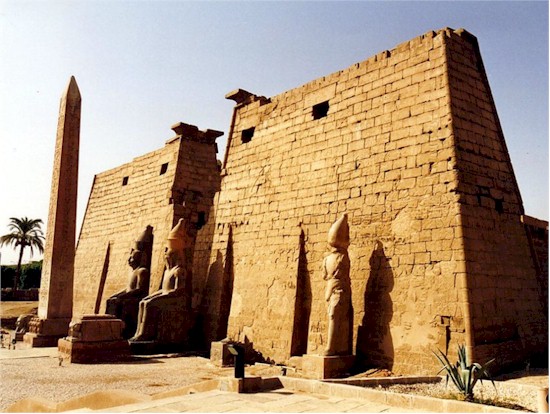
The avenue ended at the entrance to the temple of Luxor, marked by the large pylon erected by Ramses II, which features a 65-metre front decorated with bas-reliefs illustrating scenes of the military campaigns of the Pharaoh against the Hittites.
In ancient time, the pylon was preceded by two obelisks, two seated colossi and two standing colossi. Today, only the left 25-metre high obelisk is still standing: the other was taken to Paris in 1833 and placed by the engineer Lebas in Place de la Concorde on the 25th October 1836. The two colossi in granite represent the Pharaoh seated on his throne, fifteen and a half metres in height on a base of about one metre. Of the other four statues in pink granite leaning against the pylon, one was to represent Queen Nefertari and another decrepit one to the right, his daughter Merit-Amon.
Having passed through the triumphal entrance, one enters the court of Ramses II, with its double row of columns with closed papyrus capital and statues of Osiris in the inter columns. To the north-west of the courtyard one can admire the temple-deposit of the sacred boats built by Thot-Mosis III and dedicated to the triad Amon, Mut and Khonsu.
Then follows a colonnade of two rows of bell-shaped columns 52 meters long that take us to the second sourtyard, or courtyard of Amon-Ofis II, surrounded on three sides by two rows of columns with closed papyruses, a real, highly evocative forest. From here, across a transversal hypostyle hall, one enters the last sanctuary, the most intimate and sacred part, which gave the temple its name of "Adytum of the south" theatre o the final moment of the festival of Opet, the largest and most solemn held during the year.
The festival, which lasted little more than fifteen days, started on the nineteenth day of the second month of the flood, that is towards the end of August. The highlight of the ceremony came when out of the temple of Karnak came the sacred boat of Amon-Ra which carried by thirty priests and followed by those of Mut and Khonsu, covered the whole avenue of sphinxes and arrived at the temple of Luxor; here the boats were closed in the sanctuary for a couple of days, before returning to the temple of karnak, always accompanied by a rejoicing crowd singing and dancing.
|

