|
Sakkara is already famed as the home of the step Pyramid, Egypt oldest pyramid, and has been the site of constant archaeological interest. Three major discoveries have recently been made at Sakkara: a prime minister's tomb, a queen's pyramid, and the tomb of the son of a dynasty-founding king.
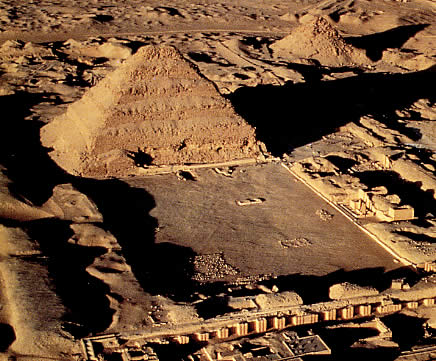
Airview of Djoser's Step Pyramid and surrounding complex at Saqqara. The pyramid to the right was built by Userkaf at the onset of the 5th Dynasty. Source: Lehner, Complete Pyramids, p. 86.
Each discovery has a fascinating story, with many adventures for the archaeologists as they revealed the secrets of the past.
Near Sakkara was the capital of Ancient Egypt during the Old Kingdom (c 2615 1990 BC), called Memphis by the Greeks but 'The White Wall' when Narmer, the first king of Dynasty 1, established the capital there. At Sakkara are the tombs of the officials of Dynasty 1 (c 3200 BC) and the tombs of most of the kings of Dynasty 2.
Sakkara is best known for the Step Pyramid, the oldest known of Egypt's 97 pyramids. It was built for King Djoser of Dynasty 3 by the architect and genius Imhotep, who designed it and its surrounding complex to be as grand as it was unique and revolutionary. Imhotep was the first to build stone tombs in honor of the king's majesty. His many titles included 'Treasurer of the King of Lower Egypt', 'Administrator of the Great Palace', and 'Imhotep the Builder, the Sculptor, the Maker of Stone Vessels'.
Dynasty 5 kings such as Userkaf and Djedkare-Izezi built their pyramids at Sakkara. The last king of Dynasty 5, Unas, decorated his burial chamber with the famous 'Pyramid Texts', spells written to help the king ascend to the heavens and descend again, which reveal the relationship of the king to the gods. Dynasty 6 kings such as Pepi I and Pepi II built their pyramids to the south of Sakkara.
Sakkara is also famous for its private Old Kingdom tombs, which contain beautiful and revealing scenes: men force- feeding geese, cattle crossing a canal, men dragging a statue on a sled to the tomb. The best-known tombs are those of Ti, Kagemni, the 'Two Brothers', and Ptahhotep; the most famous is that of Meruruka.
|


